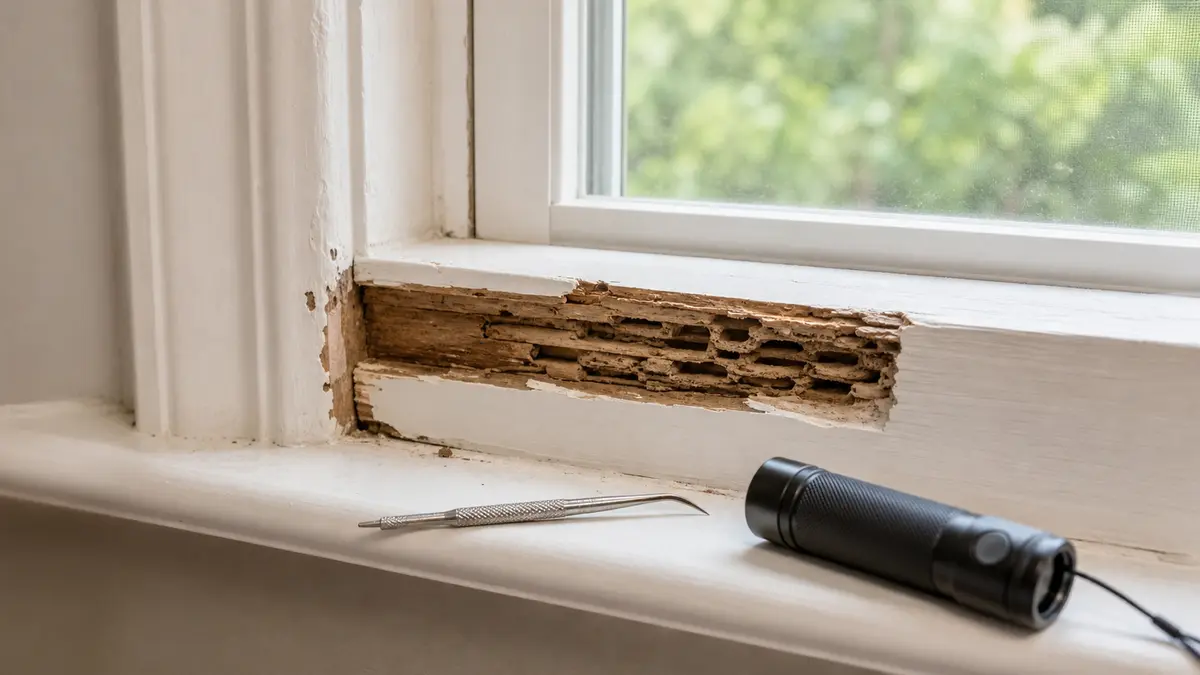
What termite-damaged window frames usually look like
Damage is only on interior trim
Casing or stool wood is chipped, tunneled, or hollow, but the window itself still feels solid and opens normally.
Start here: Start by probing the trim and the joint where trim meets the frame. If the frame stays hard and the damage is isolated, this is usually a trim repair after pest treatment.
Bottom sill area is soft
The lower frame or sill dents easily, paint is bubbled, and wood flakes off in layers or breaks into thin galleries.
Start here: Check the sill corners and underside first. Bottom-edge damage often means moisture helped the termites, and the repair may go deeper than the visible face.
Window feels loose or out of square
The sash rubs, the lock no longer lines up, or the whole unit shifts slightly when pressed.
Start here: Treat this as more than finish damage. Check whether the side jambs and sill are still solid before trying to adjust hardware or force the window.
You found mud tubes or live activity
There are pencil-width dirt tubes, pale insects, or fresh-looking debris near the frame, sill, or adjacent wall.
Start here: Stop cosmetic repair work and confirm active infestation first. Rebuilding wood before treatment usually means doing the job twice.
Most likely causes
1. Active termite infestation in damp window wood
Termites favor softened, moisture-exposed wood. Window sills, lower jambs, and trim near leaks are common starting points.
Quick check: Look for mud tubes, hollow-sounding wood, blistered paint, and galleries that follow the grain instead of random surface rot.
2. Old termite damage that was never properly repaired
Sometimes the insects are gone, but the frame was left weakened and painted over. The wood still crushes easily even without fresh activity.
Quick check: Break open a small loose area. If the tunnels look dry and abandoned and you see no fresh tubes or insects, the infestation may be old but the wood still needs repair.
3. Wood rot mistaken for termite damage
Rot and termites often show up in the same places. Rot is usually wetter, darker, and more uniformly punky, while termite galleries are more tunneled and layered.
Quick check: Probe the wood and look at the break pattern. Rot tends to crumble irregularly and stay damp; termite damage often leaves thin outer paint skin over hollow channels.
4. Damage that extends past trim into the window frame or rough opening
If the window is loose, sagging, or no longer square, the problem may involve the sill, jamb, or surrounding framing, not just the finish wood.
Quick check: Press on the jambs and sill near fastener points. Movement, deep softness, or widening gaps usually means the repair is no longer just a trim patch.
Step-by-step fix
Step 1: Figure out whether you are looking at trim damage or frame damage
This is the first split that keeps you from doing a cosmetic repair on a structural problem.
- Use a putty knife or small screwdriver to gently probe the damaged area, starting at loose paint, trim edges, and the lower sill corners.
- Press on the interior casing, stool, lower jambs, and the face of the sill. Compare damaged spots to solid wood a few inches away.
- Open and close the window once. Note whether it binds, racks, or feels loose in the opening.
- Look for separation at miters, widening gaps between trim and wall, or movement where the frame meets the wall finish.
If only the trim is damaged and the actual window frame stays hard and stable, you can usually plan for localized wood replacement after the pest issue is addressed. If the sill, jamb, or frame itself is soft or the window has lost alignment, treat it as a deeper repair and do not rely on filler or surface patching.
Stable frame with damaged trim points to a smaller finish-carpentry repair. Soft frame members or a loose window point to structural wood replacement and possible hidden wall damage.
Stop if:- The window shifts in the opening when pressed.
- Wood is soft deeper than the trim thickness.
- The sash will not operate safely or the lock no longer lines up because the frame has moved.
Step 2: Check for signs that termites are still active
You do not want to rebuild wood over an active infestation.
- Inspect the damaged area, nearby drywall edges, and the wall below the window for mud tubes, fresh dirt lines, or live pale insects.
- Look outside at the sill, trim, and foundation line below the window if accessible. Termite tubes often bridge from masonry or soil to wood.
- Break open one loose, already-damaged section carefully and look for fresh-looking galleries, live insects, or moist packed material inside.
- Note whether the damage looks dry and abandoned or fresh and active.
If you find clear active signs, line up pest treatment first and keep repairs limited to temporary protection and documentation until treatment is underway. If you find no active signs, continue checking how far the wood damage goes before deciding on repair materials and scope.
Active evidence means the source problem is not solved yet. No active evidence does not guarantee safety, but it makes repair planning more realistic once the damaged wood is mapped out.
Step 3: Separate termite galleries from plain rot or mixed damage
Rot changes the repair plan because you also need to solve the moisture source, not just replace wood.
- Check whether the wood feels damp, stains nearby finishes, or shows repeated water exposure at the sill or lower corners.
- Look at the broken wood. Termite damage usually leaves layered tunnels and thin outer skins; rot is more uniformly soft and stringy or crumbly.
- Inspect caulk joints, exterior paint failure, and any obvious leak path above the window.
- If the area is dry now but clearly water-marked, assume moisture helped create the conditions even if termites did the chewing.
If the damage is mostly dry termite galleries with otherwise sound surrounding wood, the repair may stay localized once treatment is handled. If the wood is wet, stained, or rotted beyond the visible damage, solve the moisture path before rebuilding or the new wood will not last.
Step 4: Map the full extent before you cut anything out
Window repairs go sideways when you remove more wood than expected without knowing what still supports the unit.
- Mark the soft or hollow areas with painter's tape or pencil as you probe outward into solid wood.
- Check both lower corners, the full sill edge, and the lower 12 to 18 inches of each side jamb.
- Remove only loose trim pieces first if they are already detached or clearly non-structural.
- If the damage stops in trim or a non-structural stool, plan a like-for-like wood replacement. If it continues into the sill or jamb, plan for a more involved frame repair or pro assessment.
If you can clearly define a small, solid boundary around the damage, the repair is more likely to be manageable and durable. If the damage keeps extending, disappears behind finished surfaces, or reaches the frame corners, stop before demolition turns a window repair into an unsupported opening.
Step 5: Choose the repair path that matches what you found
At this point you should know whether this is a trim replacement, a localized wood rebuild, or a stop-and-call job.
- If damage is limited to removable interior or exterior window trim and the frame is solid, replace the damaged window trim board with matching material after pest treatment or confirmed inactive damage.
- If the window sill nose or stool has localized damage but solid wood remains behind it, cut back to sound material and rebuild with matching wood rather than smearing filler over hollow sections.
- If the sill, jamb, or frame members are soft, loose, or out of square, get pest treatment and a carpenter or window repair pro involved before rebuilding.
- After repair, prime and paint exposed replacement wood and keep joints maintained so the area does not stay damp.
A good result: A proper repair leaves you with solid wood, a stable window, and no hidden hollow spots around the opening.
If not: If the window still moves, binds, or shows new softness after you expose the area, the damage is deeper than a surface repair and needs a larger rebuild.
Small trim-only damage is a repair. Soft frame members, movement, or hidden spread turn it into a structural window-opening job.
Replacement Parts
As an Amazon Associate I earn from qualifying purchases. Repair Riot may earn a commission at no extra cost to you.
FAQ
Can I just fill termite holes in a window frame with wood filler?
Not until you know the wood behind the surface is solid. Filler works on small, shallow defects in sound wood. It fails fast when the wood is hollow, soft, or still active with termites.
How do I tell termite damage from rot around a window?
Termite damage usually shows galleries and hollow channels under a thin painted surface. Rot is more uniformly soft, damp, and crumbly. Around windows, the two often overlap because moisture makes the wood easier for termites to attack.
If the termites are gone, do I still need to replace the wood?
Usually yes if the wood crushes easily, will not hold fasteners, or lets the window move. Old damage can still leave the frame too weak to trust even when the infestation is no longer active.
Is termite damage around a window usually structural?
Not always. Sometimes it is limited to casing, stool, or other trim. But once the sill, jamb, or frame corners are soft, the job moves beyond cosmetic repair because the window may no longer be properly supported.
Should I repair the window first or treat for termites first?
If there are signs of active termites, treatment comes first or at least gets arranged before rebuilding. Otherwise you risk closing up active damage and having to tear the repair back out.
When is full window replacement more likely than a local repair?
When the sill and jambs are both compromised, the frame is out of square, or the damage runs into the rough opening and surrounding wall framing. At that point, a carpenter or window pro should decide whether rebuilding the opening or replacing the unit makes more sense.