Thump only with certain loads
Shoes, towels, rugs, or one heavy item make a loud rhythmic bump, but the dryer is much quieter empty.
Start here: Start with load balance and drum contents before opening the dryer.
A Speed Queen dryer thumping noise is usually caused by something rotating with the drum: a heavy item bouncing, a drum seam thump, a flat-spotted support roller, or a worn dryer belt idler area. Start by listening for when the thump happens and whether it changes as the dryer warms up.
Most often, the first check is the load itself or a support roller that thumps loudly at startup and gets a little better after a few minutes.
A true thump is different from a scrape, squeal, or rattle. If the sound is a steady bump-bump-bump that matches drum rotation, you can usually narrow it down pretty quickly. Reality check: one pair of shoes or a wet bath mat can sound like a bad dryer. Common wrong move: replacing heating parts for a noise problem just because the dryer still dries poorly.
Don’t start with: Don't start by ordering random internal parts or running the dryer over and over with a hard thump. A seized roller can wear the belt and drum support surfaces fast.
A steady thump is usually tied to the drum support path, not the control panel. The drum rollers, idler, and belt are the parts to think about once the load itself has been ruled out.
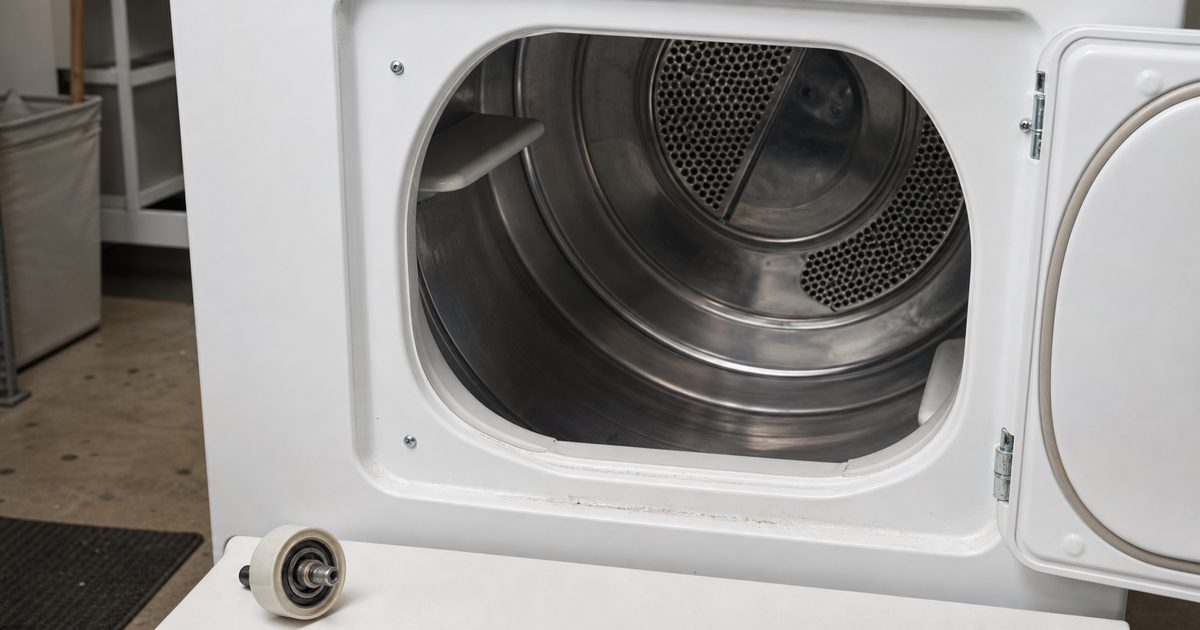
Shoes, towels, rugs, or one heavy item make a loud rhythmic bump, but the dryer is much quieter empty.
Start here: Start with load balance and drum contents before opening the dryer.
The dryer makes the same bump-bump sound with no clothes inside.
Start here: That points away from the load and toward drum rollers, the idler area, or something stuck to the drum.
The noise is heavy on startup, then softens as the dryer runs.
Start here: A flat-spotted dryer drum roller is the leading suspect.
You hear one distinct thump at the same spot every rotation.
Start here: Check for a drum seam thump, something stuck inside the drum, or a damaged drum support component.
One heavy wet item, shoes, or a twisted sheet can slap the drum and sound mechanical even when the dryer itself is fine.
Quick check: Run the dryer empty. If the thump disappears, reload with a balanced mixed load and test again.
When a dryer sits or a roller wears, it can develop a flat spot that makes a rhythmic thump once per turn, often louder when cold.
Quick check: Listen for a startup thump that improves slightly after a few minutes of running.
A raised seam, hardened residue, or a small object caught at the drum edge can make one repeatable bump every rotation.
Quick check: Turn the drum by hand with power disconnected and feel for one spot that bumps or catches.
If the belt runs unevenly or the idler pulley is worn, the drum can move less smoothly and produce a dull repeating knock or thump.
Quick check: If the noise stays with an empty drum and does not change much with load size, inspect the belt path and idler area.
A lot of dryer thumping is just a heavy or awkward load bouncing around, and this is the fastest safe check.
If the thump is gone empty and stays gone with a balanced load, the dryer likely does not need parts. If the thump is still there with an empty drum, move on to the drum and support checks.
A noise that disappears empty is usually not an internal failure.
The timing of the sound tells you whether you're chasing a seam thump, a roller problem, or a loose object.
If you find and remove a stuck item or residue and the drum turns smoothly, test the dryer again. If the drum still has a repeating bump or the noise returns empty, the support parts underneath are more likely.
One repeatable spot in the rotation often points to the drum surface or a support part turning out of round.
A worn dryer drum roller often thumps hardest when cold, then quiets down a little as it warms up.
If the startup thump clearly eases as the dryer warms, you've got a strong case for worn dryer drum rollers. If the thump stays equally hard the whole time, keep checking the belt path and drum support area.
Once the noise is confirmed with an empty drum, the next useful check is the rotating support hardware, not guess-buying parts.
If you find a roller that is flat-spotted or rough, or an idler pulley that feels loose or gritty, you have a supported repair path. If the rollers, idler, and belt look good, the drum or another internal part needs a closer teardown.
Once you have a clear failed part, the right move is to replace that support component and confirm the drum turns smoothly before regular use.
A good result: If the dryer runs smoothly empty and with clothes, the repair is complete.
If not: If the same thump remains after confirmed support-part replacement, stop and inspect for a damaged drum or get a service tech involved.
A thump that survives good rollers, idler, and belt usually means the problem is deeper than routine wear parts.
As an Amazon Associate I earn from qualifying purchases. Repair Riot may earn a commission at no extra cost to you.
That usually points to a flat-spotted dryer drum roller. The roller can make a hard bump when cold, then smooth out a little as it warms from use.
Yes, but not as often as a roller. A damaged or unevenly worn dryer belt can create a repeating knock, especially if it has been running over a bad idler pulley or roller.
A light load thump from shoes or a bulky item is one thing. A hard mechanical thump with an empty drum is different. Keep using it and you can wear out the belt, drum support parts, or drum surfaces faster.
That usually means the noise is inside the dryer, not the load. The most likely causes are a flat-spotted dryer drum roller, a worn dryer idler pulley, or a repeatable bump from the drum itself.
Not always. Replace what you can clearly confirm is worn. If one roller is bad and the others feel smooth and tight, you may only need the failed part. If several support parts show wear while the dryer is open, many homeowners replace them together to avoid doing the teardown twice.